
AI-MSET™AI-MSET™ | Executive Technology Overview Technology
Detecting the anomalies that conventional monitoring cannot see

Discover incipient degradation while signals still appear normal. AI-MSET™ is True North Prognostics’ third-generation Multivariate State Estimation Technique: an advanced prognostic AI that learns how complex systems behave and identifies the earliest departures from that learned behavior (and with ultra-low false- and missed-alarm probabilities). AI-MSETTM transforms existing sensor and operational telemetry into actionable warnings—often before a developing fault is visible to conventional monitoring, and while maintenance teams have time to intervene and fix tiny developing faults before the faults evolve into serious outages or catastrophic failures of costly assets.
The critical distinction: inliers, not just outliers
Conventional high/low alarms detect outliers: individual measurements that have crossed preset thresholds. But many developing defects first appear as subtle changes in relationships among signals—temperature versus power, vibration versus rotational speed, pressure versus flow—while every individual measurement remains inside its normal noise band.
These incipient faults are univariate “inliers.” Because no single signal crosses its high or low limit, a conventional univariate threshold cannot detect them at that stage. AI-MSET detects the abnormal multivariate pattern, including degradation signatures below the noise floor of the original sensor measurements. This is the basis for much earlier warning without flooding operators with nuisance alarms.
How AI-MSET delivers high-sensitivity early warnings
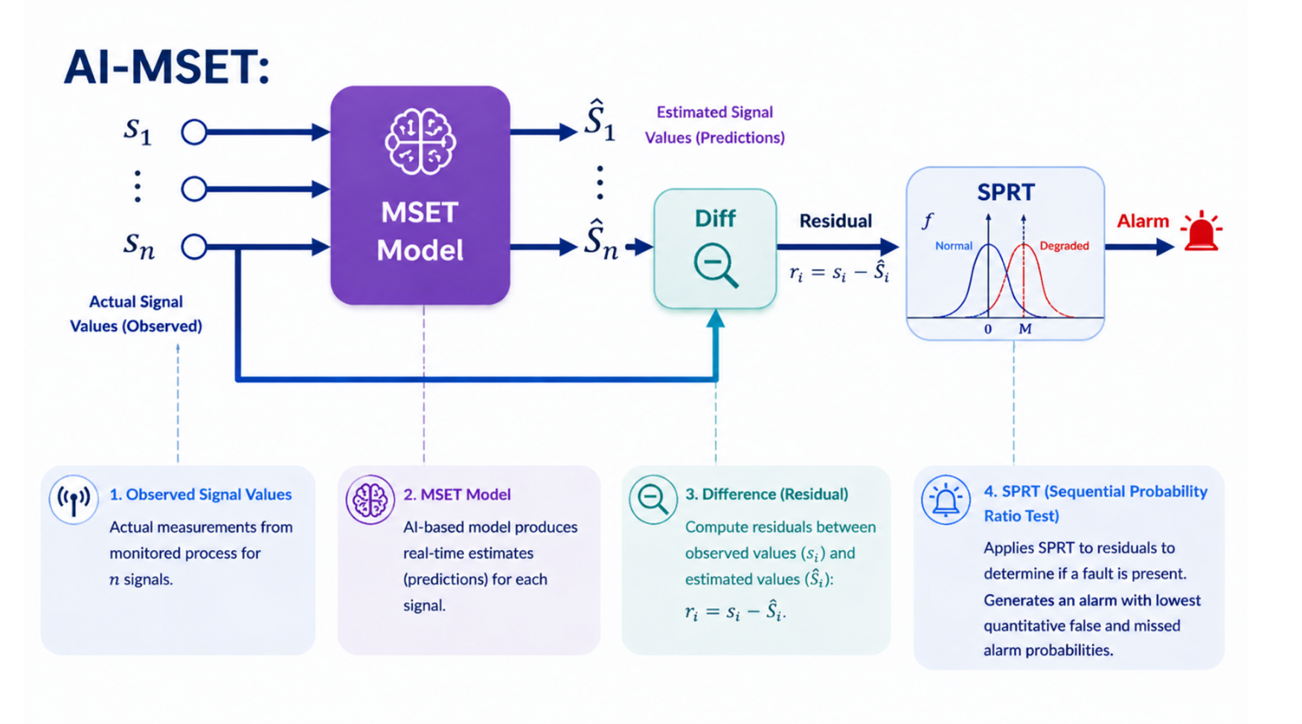
AI-MSET learns normal operating relationships from validated historical telemetry. During operation, it continuously estimates what each signal should be, given the behavior of all the other correlated signals. The differences between measured and estimated values—residuals—expose subtle degradation that may remain hidden within the variability of raw sensor signals.
Those residuals are evaluated using Wald’s Sequential Probability Ratio Test (SPRT), with independently specifiable false-alarm and missed-alarm probabilities. SPRT is mathematically optimized (and autonomous based upon the empirical signal-to-noise ratios (SNR) of all monitored signals … no data scientist has to fiddle with hyper-parameters, nodes, layers, epocs as is the case for neural nets) … for early statistical decisions of incipient anomalies, days and often weeks before signals might exceed high/low thresholds, enabling rapid annunciation of incipient anomalies high confidence factors and with ultra-low nuisance-alarm rates.
Proven heritage, advanced for modern telemetry
The original MSET was invented at the U.S. Department of Energy’s Argonne National Laboratory and developed for nuclear-plant prognostics. Over three decades, subsequent generations have supported high-stakes applications in energy, aerospace, transportation, manufacturing, and mission-critical computing. AI-MSET builds on this heritage with third-generation advances in intelligent data preprocessing, model training and optimization, sensor operability validation, and scalable real-time analytics.
Its compact computational architecture enables deployment from edge devices to enterprise-scale infrastructures. In representative high-dimensional telemetry workloads, AI-MSET offers computational efficiencies two to three orders of magnitude greater than neural-network-based approaches, while providing unusually sensitive anomaly detection and rigorous control of false and missed alarms.
From historical data to continuous prognostic surveillance
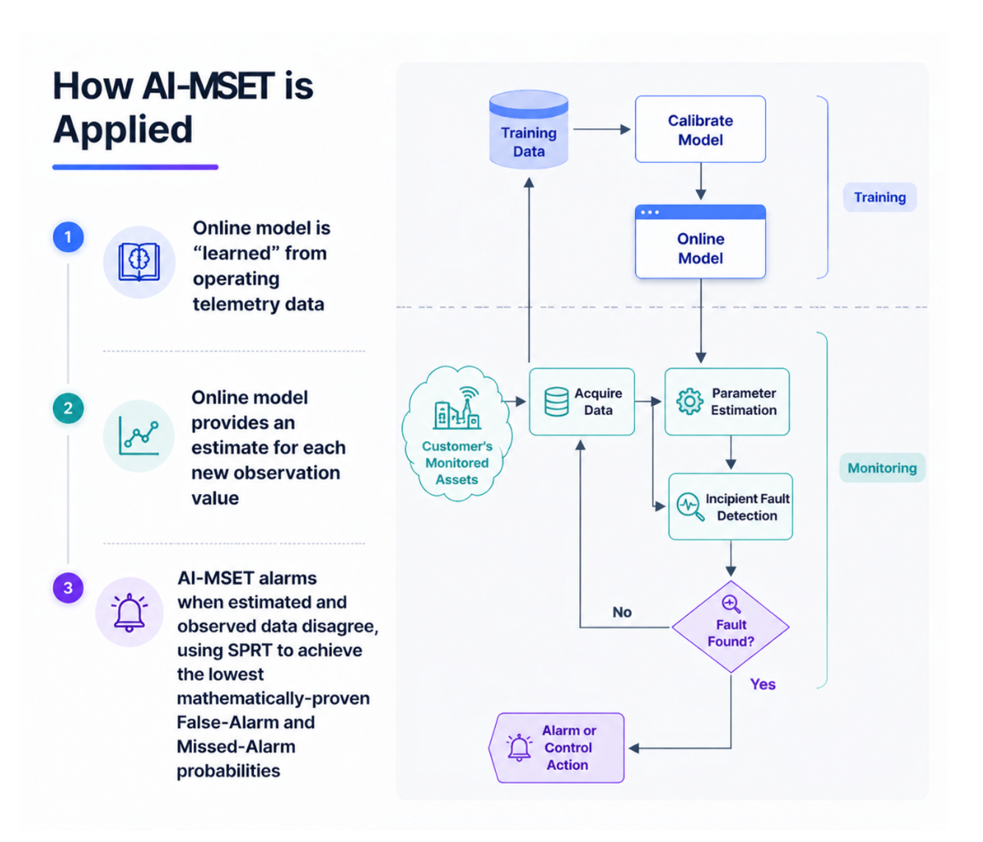
Train: select representative, validated normal-operation memory vectors spanning relevant loads, operating regimes, and environmental conditions. Monitor: estimate expected behavior from incoming observations; scrutinize residuals with SPRT; and issue alerts when the data reveal developing faults. Sensor-validation and intelligent preprocessing capabilities help preserve sensitivity in the presence of noisy, quantized, or imperfect field telemetry.
Business impact across mission-critical assets
Earlier intervention, enabling Predictive & Prescriptive Maintenance: Detect subtle sensor and asset embryonic degradation modes while there is still time to schedule corrective action and avoid unplanned downtime.
Fewer false alarms and no-fault-found (NFF) events. Reduce unnecessary shutdowns, maintenance dispatches, and operator alarm fatigue without sacrificing incipient-fault sensitivity.
Higher Reliability, Availability, and Serviceability (RAS) and improved Safety Margins for safety-relevant engineering and transportation assets. Support proactive serviceability for equipment whose unexpected failures create high financial or safety consequences.
Scalable, low-friction deployment. Apply software-based prognostics to existing data historians, industrial IoT streams, and IT telemetry without requiring any new sensors in any existing field assets.
Applications span nuclear and utility-grid assets; manufacturing processes; commercial and defense aviation; railroads and other transportation; SCADA and industrial cybersecurity; and large-scale enterprise and AI data centers.
Measure the advantages using your own data-historian archives. A focused proof of concept (POC) on existing telemetry can quantify warning lead time, false- and missed-alarm performance, computational efficiency, and avoided operational costs.