
Electronic Prognostics
Proactive Detection of Degradation in CPUs, GPUs, and System Boards
The HPC and AI Data Center Reliability Challenges
Modern enterprise data centers operate some of the most valuable computing assets in the world. Large-scale clusters composed of CPUs, GPUs, ASICs, and densely populated system boards support mission-critical AI training, inference, analytics, and cloud workloads. These assets are expected to operate continuously, often under extreme thermal, electrical, and duty-cycle stresses.
Despite extensive onboard instrumentation, unexpected hardware failures remain common and increasingly expensive. When CPUs, GPUs, or System Boards fail without warning, the consequences include lost availability, degraded cluster throughput, emergency maintenance, and significant operational disruption, especially during long AI training runs.
The root cause is not a lack of telemetry. Modern servers and accelerators generate enormous volumes of data. The problem is that conventional monitoring approaches cannot interpret this data in a predictive way.
Quantized Signals Mask Early Degradation
Many telemetry signals in modern enterprise hardware are quantized by design, with a leading source of quantization originating in low-resolution Analog-to-Digital (A/D) conversion chips embedded throughout servers, GPUs, system boards, and power delivery subsystems. For cost, bandwidth, and legacy reasons, most platforms rely on 8-bit (or similarly low-resolution) A/D converters, which fundamentally limit signal fidelity before the data ever reaches monitoring software.
As a result, many commonly used telemetry signals appear as:
Integer-valued temperatures
Discretized voltage and current readings
Coarse fan speed measurements
Counters, flags, and error registers
Early-stage degradation mechanisms rarely produce large excursions in any single signal. Instead, they manifest as subtle, correlated pattern changes across many signals. Quantization collapses these continuous dynamics into “stair-step” behavior, masking early degradation signatures and causing conventional anomaly detection algorithms to suffer from:
Elevated false-alarm probabilities (Type-I errors)
Elevated missed-alarm probabilities (Type-II errors)
Elevated No Faults Found (NFFs) for returned Field Replaceable Units (FRUs)
TNP DeQuantize: Restoring Signal Fidelity Up-Stream of EP (NEW)
TNP solves this problem using DeQuantize, a signal-reconstruction capability applied up-stream of the core multivariate anomaly detection algorithm (AI-MSET™).
DeQuantize transforms low-resolution, quantized telemetry into high-fidelity signals that more accurately represent the underlying physical behavior of the hardware, without requiring any new sensors or hardware changes. Depending on the severity of quantization, DeQuantize reconstructs lost dynamics using proven spectral and statistical techniques derived from expired prior art.
By restoring meaningful signal structure before anomaly detection is performed, DeQuantize:
Dramatically reduces false alarms caused by quantization artifacts
Prevents missed detection of early degradation
Enables AI-MSET™ to fully exploit multivariate correlations that are otherwise hidden
This DeQuantize → AI-MSET™ architecture is essential for achieving reliable Electronic Prognostics in modern data centers and is a key reason why TNP’s EP outperforms conventional monitoring approaches.
Univariate Monitoring Does Not Scale
Conventional monitoring treats each signal independently, applying fixed high/low thresholds. In a large GPU cluster with hundreds of thousands or millions of telemetry signals, this approach is fundamentally unscalable and blind to system-level behavior.
Individual signals may remain “within limits” and not generate high/low threshold alerts while the system as a whole is already degrading (as AI-MSET™ catches from anomalous correlation patterns).
Thresholds Detect Failures Too Late
Threshold-based alarms typically fire only when damage is already significant and failure is imminent. At that point:
Emergency board replacement is required
MTTR increases
Spare inventory must be maintained on site
Cluster availability is directly impacted
What Is Electronic Prognostics (EP)?
Electronic Prognostics (EP) is a multivariate anomaly detection algorithm that monitors all telemetry metrics for a server, learns the patterns of correlation between and among all the signals while the server is in a healthy state, and then, in surveillance mode, EP is very well proven with business-critical IT systems in data centers to achieve proactive detection of the incipience and early progression of degradation mechanisms that lead to electronic failures of chips, system boards, or anomalies that cause entire servers to crash.
EP does not wait for alarms -- IT PREDICTS FAILURES BEFORE THEY OCCUR.
TNP’s EP capability is powered by AI-MSET™, a multivariate machine-learning approach designed to model normal system behavior and detect subtle deviations in learned correlation patterns that indicate emerging faults in CPUs, GPUs, and system boards.
Statistical Detection with Extremely Low False Alarm Probabilities
Deviations from the learned multivariate baseline are evaluated using Sequential Probability Ratio Tests (SPRTs). When combined with DeQuantize telemetry, this provides:
Statistically rigorous change-point detection
Confidence-graded alerts
Extremely low false-alarm and missed-alarm probabilities, even in highly instrumented, quantized environments
Solving the Supplier’s NFF Problem
For system manufacturers and component suppliers, unexpected failures create an additional challenge: No-Fault-Found (NFF) board returns.
Quantization-induced false alarms and missed detections are a major contributor to NFFs, because boards are often removed from service without any reproducible failure signature. AI-MSET™ enabled logical Black Box Recorder (BBR) files — generated from DeQuantized multivariate telemetry — eliminate NFFs by providing quantitative, time-resolved degradation signatures. These signatures allow design engineers and component suppliers to:
Pinpoint the true onset of degradation
Distinguish real failure mechanisms from monitoring artifacts
Disambiguate sensor anomalies from anomalies in the assets
Provide fast, accurate, reproducible Root Cause Analysis to provide quantitative Pareto Analyses, enabling the supplier’s design teams to prioritize mods in the next platform upgrades to eliminate the most prominent (or most costly) fault mechanisms in future platform revisions
How AI-MSET™ Enables Predictive Detection
Multivariate Pattern Learning with AI-MSET™
AI-MSET™ models the normal multivariate behavior of complex electronic systems, including:
Processors
Power delivery networks
Thermal subsystem
Memory and interconnects
Board-level electronics
Rather than evaluating signals one at a time (traditional univariate anomaly detection), AI-MSET™ learns how dozens, hundreds, or thousands of dynamic signals behave together under healthy operating conditions. This multivariate-trained AI model becomes a high-fidelity baseline against which all future behavior is compared.
Because degradation mechanisms affect multiple subsystems simultaneously, pattern-based detection is essential.
Statistical Detection with Extremely Low False Alarms
Deviations from the learned multivariate baseline are evaluated using Sequential Probability Ratio Tests (SPRTs). This provides:
Statistically rigorous change-point detection
Confidence-graded alerts
Extremely low false-alarm and missed-alarm probabilities
The result is early, reliable predictive warnings, often days or weeks before failure, without overwhelming operators with noise.
Enabling Dynamic Reconfiguration (DR)
Predictive lead time enables a powerful operational capability: Dynamic Reconfiguration (DR).
When AI-MSET™ identifies a system board at risk:
Workload mobility software migrates active workloads to healthy (idle-standby) board in a nearby machine
The at-risk board is transitioned to an idle state.
The board is replaced during planned maintenance.
Workloads are dynamically reconfigured back onto the new board.
The end customer never experiences an outage. Failures are prevented rather than reacted to.
Black Box Recorders (BBRs) and Traceback Root Cause Analysis (RCA)
TNP’s EP solution includes Black Box Recorder (BBR) files.
BBRs are not physical devices. They are compact, logical flat files stored in the data historian DB alongside existing OS log files and telemetry archives (e.g., Prometheus™ and/or DCGM™ exports).
BBRs capture:
Pre-failure telemetry history
AI-MSET™ residuals
Exact SPRT alarm traces identifying exact individual or combinations of multiple signals are exhibiting degradation, with exact timestamps for the onset of early-warning anomalous behavior, and shows the dynamic evolution of a “severity index” for the asset, see publications in the Bibliography from real use-case examples of high-end enterprise servers in data centers. This enables fast, accurate traceback root cause analysis (RCA)
Proven Lineage, Failure Mechanisms, and Business Impact
Pioneering Experience in Electronic Prognostics
TNP’s technology innovators bring over two decades of pioneering experience in MSET- and SPRT-based Electronic Prognostics for complex engineered systems. Through extensive refereed journal and conference publications, they demonstrated how multivariate models can learn the correlation patterns present in normal systems and apply those models to hundreds of thousands of telemetry signals across large computing environments.
This work established the capability to proactively detect the incipience of degradation mechanisms leading to failures of CPUs, GPUs, system boards, and the diverse electronic and electromechanical components mounted on those boards.
The original MSET methodology revolutionized multivariate anomaly detection across industries ranging from nuclear energy and aerospace to enterprise IT. TNP’s third-generation AI-MSET™ builds on that foundation, achieving even lower false-alarm probabilities, scaling to million-sensor fleets, and operating out-of-the-box with modern telemetry frameworks including Prometheus™, Redfish™, Sentry™, and NVIDIA™ DCGM™.
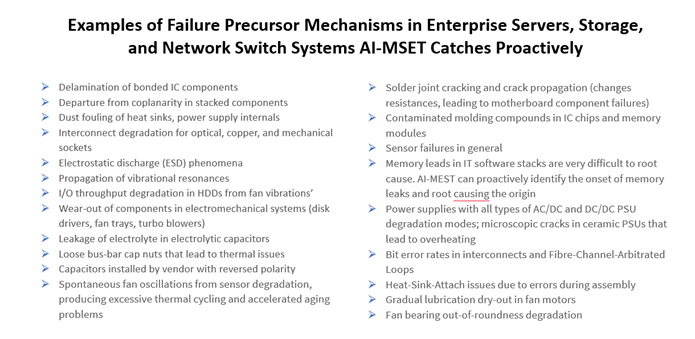
Failure Precursor Mechanisms Detected by AI-MSET™
AI-MSET™ has demonstrated the ability to proactively detect the onset of a wide range of degradation mechanisms that ultimately cause enterprise computing failures. These include mechanical, thermal, electrical, and materials-related mechanisms affecting CPUs, GPUs, and system boards.
Below (Table 1) provides representative examples of CPU and GPU package failure precursor mechanisms proactively detected by AI-MSET™, including solder joint degradation, thermal attach issues, power delivery degradation, interconnect wear-out, vibration-induced failures, capacitor aging, and sensor drift.
Solving the Supplier’s NFF Problem
For system manufacturers and component suppliers, unexpected failures create an additional challenge: No-Fault-Found (NFF) board returns.
Returned boards that cannot be reproduced in test environments:
Drive massive sparing inventories. If a platform has a 50% NFF rate for expensive System Boards, there needs to be 50% more spares in the sparing depots around the world
Complicate paring supply-chain logistics and challenges service-level-availability (SLA) contracts
Obscure true failure mechanisms
Slow platform improvement cycles
AI-MSET™ enabled BBRs eliminate NFFs by providing quantitative, time-resolved degradation signatures. These signatures allow design engineers and component suppliers to identify root causes precisely and eliminate failure mechanisms in future platform revisions.
Economic Impact and Summary
For enterprise Owners, EP enables:
Near-zero unplanned outages
Significantly reduced MTTRs
Smaller on-site spare inventories
Predictable cluster performance
For Suppliers, EP enables:
Elimination of NFFs
Reduced global spares
Faster service resolution
Accelerated design improvement
Improved reliability & customer satisfaction
Electronic Prognostics powered by AI-MSET™ transforms enterprise computing reliability from reactive monitoring to predictive prevention with confidence.
It is advanced reliability engineering for the AI era.
Electronic Prognostics Bibliography
Historical Perspective
EP Predictive Detection of Incipient Degradation Modes in High-End Enterprise Servers
“No Faults Found” Avoidance for Failed System Boards"
Original development of MSET-based Electronic Prognostics (proactive detection of all types of incipient degradation mechanisms that cause CPUs, GPUs, System Boards, and Enterprise Servers to be at elevated risk of failure, days and often weeks in advance of failure), and avoidance of “No Faults Found” (NFFs, also called “No Trouble Found” NTFs).